5303918214 is a high-voltage ignition component within the BSH Group part-numbering system, primarily used for ignition control in gas-fired kitchen appliances and heating equipment. This article provides a systematic overview of its structural composition, technical parameters, typical applications, compatibility identification, and installation considerations, intended for service engineers, OEM design engineers, and field installation technicians.
The 5303918214 follows the BSH Group’s standardized part-numbering system, consisting of 10 digits and commonly appearing within the 5xxx and 6xxx component series. This numbering convention has the following characteristics:
The prefix segment indicates the product category (ignition / control / valves / sensors, etc.);
The middle segment represents the product family and structural code;
The suffix segment denotes the version and variant code.
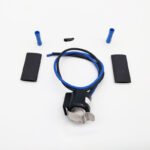
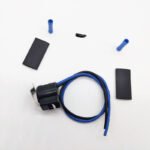
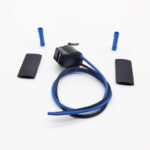
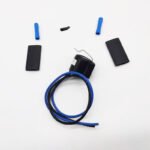
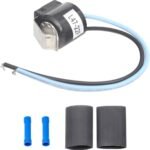
As shown in the product image, 5303918214 is an integrated ignition module consisting of a high-voltage transformer, output leads, and an insulation protection kit. Its main components are as follows:2.1 High-Voltage Transformer Body
Black flame-retardant plastic housing compliant with UL94 V-0 or equivalent household appliance standards;
Metal mounting bracket and HV output terminals on top (for connection to the igniter electrode or distributor);
Product label containing the part number, production batch, and certification marks.
2.2 Output Lead Assembly
Typically a dual-lead output (one blue, one black), serving the circuits of two igniter electrodes;
Outer insulation rated for high temperature and aging resistance, capable of withstanding the high-frequency, high-voltage pulses from the transformer secondary;
Lead length and terminal form vary by appliance model; the original wiring configuration must be verified before replacement.
2.3 Insulation Protection Kit
A set of black and blue heat-shrink tubes, used for re-insulating joints during replacement;
Heat-shrink tubes feature a dual-wall construction with an inner adhesive layer, providing better sealing performance after shrinkage, effectively preventing moisture ingress and electrical leakage.
2.4 Auxiliary Sealing Components
The small black rubber part visible in the image is typically used as a lead-through grommet or terminal sleeve, and must not be omitted during installation — otherwise the overall ingress protection rating of the unit may be compromised.
Ignition modules of the 5303918214 type are commonly found in the following equipment:
Domestic gas cooktops — particularly multi-burner built-in units with flame-failure protection;
Gas ovens and combi-steam ovens — for ignition of the cavity burner;
Gas water heaters and wall-hung boilers — serving as the excitation source for the main or pilot burner;
Selected commercial cooking appliances — earlier European commercial equipment occasionally uses components of this type.
Although 5303918214 is a clearly defined part number, the following verification sequence is recommended during service work:
Confirm the appliance E-Nr.: The relationship between BSH appliance model numbers and component part numbers is not strictly one-to-one. The 5303918214 must be confirmed against the E-Nr. spare-parts list (Ersatzteilliste).
Check the version code: Some appliances include Rev. / Version identifiers, which may correspond to different component variants.
Review the alternative part-number list (Alternative Teilenummern): Factory documentation typically lists interchangeable part numbers, such as other entries within the 5303 xxx xxx range.
Perform a structural comparison: If there are differences in lead length, terminal form, or bracket dimensions between the old and new parts, the impact on wiring routing and bracket fit must be evaluated in advance.
Engineer’s Note: Direct replacement based on visual similarity alone is a common source of subsequent failures. Even within the same manufacturer’s product family, a difference of a few centimeters in lead length can result in unacceptable wiring stress or safety clearance.
Power-off operation: Always disconnect the appliance from the power supply and allow the cavity to cool down before replacement.
Avoid pulling on the leads: The root of the HV output lead is a stress concentration point. Sufficient slack and proper fixing should be provided during routing.
Maintain creepage and clearance distances: The clearance between HV terminals and LV circuits must comply with factory specifications.
Complete insulation treatment: Heat-shrink tubing at joints must be fully shrunk, with no bubbles or damage.
Energize test: After installation, perform a no-gas test spark to confirm both ignition paths spark normally, then restore the gas supply for functional verification.
EMC considerations: Ignition events generate broadband electromagnetic interference. Signal cables should be routed as far as possible from the ignition module and HV leads.
Q1: Is 5303918214 interchangeable with other part numbers in the 5303 series?
A: Not necessarily. The series includes various lead lengths, lead colors, and terminal forms. Always verify against the E-Nr. spare-parts list.Q2: Can the module be continuously energized without igniting?
A: No. Ignition components are designed for short-time duty. Continuous energization will accelerate coil aging and may lead to burnout.Q3: If the spark appears normal but the gas does not ignite, is the ignition module necessarily faulty?
A: Not necessarily. The gas valve assembly, clogged nozzle, misaligned igniter electrode, or poor grounding can all cause similar symptoms. A systematic “gas — electrical — spark — position” check should be performed.Q4: Can the component be replaced by the user?
A: Replacement is possible for users with basic electrical knowledge and an understanding of gas-safety practices. If gas-line adjustment is involved or the appliance is under warranty, however, a certified technician should be engaged.
In gas-fired appliances, the ignition module is a small component with a direct impact on both operational safety and equipment stability. The value of an OEM-specified part such as 5303918214 lies not only in the part number itself, but in its engineered alignment with the appliance’s overall design, insulation structure, and electrical parameters. This article is intended to provide service and engineering professionals with a more complete technical basis for identification, verification, and installation.